Skip to main content Skip to main navigation menu Skip to site footer
logo-soc
  • Current
  • Archives
  • About
    • About the Journal
    • Submissions
    • Privacy Statement
    • Contact
  • Login

Search Socrates: Journal of Education, Philosophy and Psychology

Press Enter to search · Esc to close Advanced search →
logo-soc
  • Current
  • Archives
  • About
    • About the Journal
    • Submissions
    • Privacy Statement
    • Contact
  • Login
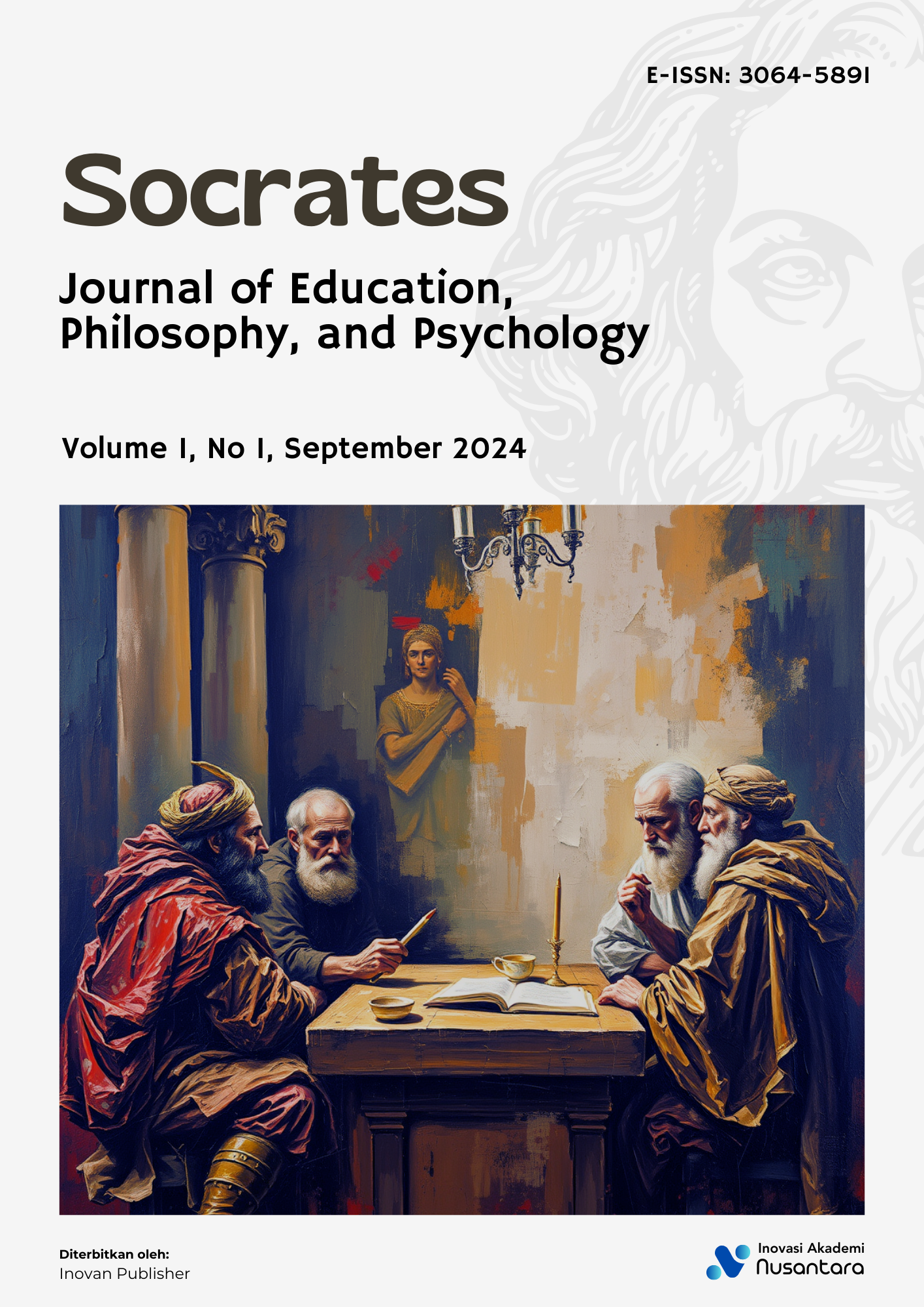
Home/ Archives/ Vol. 1 No. 1 (2024): Socrates: Journal of Education, Philosophy and Psychology
Vol. 1 No. 1 (2024): Socrates: Journal of Education, Philosophy and Psychology

Vol. 1 No. 1 (2024)

Socrates: Journal of Education, Philosophy and Psychology

Published September 1, 2024

This edition has been available online since September 2024. All articles in this edition consist of (5 original research articles) co-authored by 8 authors from 2 Universities and 1 Country (Indonesia).
5 articles 8 authors 1 countries
8

DOIhttps://doi.org/10.63217/socrates.v1i1

  • Articles

    Improving Vocational Skills in Making Wall Decorations from Ice Cream Sticks Through Explicit Instruction Models for Children with Mild Mental Disabilities

    Devia Aryati

    Universitas Negeri Padang, Padang, Indonesia

    pp. 1-6 DOIhttps://doi.org/10.63217/socrates.v1i1.42
    PDF
    Abstract

     This research is based on the problems found in class VIII SLB WacanaAsih, in one practice room there are five students with mild mental retardation and there are two students who are not yet skilled in the skills of making wall decorations from ice sticks. Previously, children had learned skills from ice sticks such as making a pencil case for auspidol but were unsuccessful in the process, therefore this research was conducted using ice sticks through the explicit instruction model, in this study it will be carried out with two cycles, each cycle consists of: planning, implementation of actions, observation and reflection. The data collection techniques used are observation, documentation, and performance tests. Based on the results obtained by students using two cycles, namely the Ga value in cycle I action is 88.7%, and in cycle II obtained a value of 91.9%, while Ge students obtained a value in cycle I of 64.5%, and in cycle II obtained a value of 82.3%, Gi students in cycle I action are 88.7%, and in cycle II obtained a value of 91.9%, Fa students in cycle I action are 88.7%, and in cycle II obtained a value of 91.9%, and Pu students in cycle I action are 74.2%, and in cycle II obtained a value of 85.5%. Based on the data above, the conclusion of the skill of making wall decorations from ice sticks has increased significantly through the explicit instruction model.

  • Articles

    Improving Early Reading Skills Through Kokami Media for Children with Mild Mental Retardation

    Ages Budiman

    Universitas Negeri Padang, Padang, Indonesia

    pp. 7-12 DOIhttps://doi.org/10.63217/socrates.v1i1.43
    PDF
    Abstract

    This research was motivated by the existence of problems in children with mild mental retardation in grade IV / C at SLB YPAC West Sumatra, who had difficulty reading at the beginning. Children have difficulty arranging letters into syllables where the child is unable to read the KV pattern syllables (consonant-vowels). Based on the above problems, this study aims to prove that kokami media is able to improve the ability to read beginning, namely reading KV patterned syllables for children with mild mental retardation. The design used in this study is the A-B-A design with the single subject reaserch (SSR) method and the target behavior, namely stringing letters into syllables by reading syllables with a KV pattern (consonant-vowel). The results of this study indicate that the kokami media is able to improve the ability to read early on in children with mild mental retardation. In the inter-condition analysis, the number of variables analyzed with the results of the analysis tends to be stability at conditions A1 0%, B + 12.5% ​​and A2 + 100%. The percentage of overlap at baseline conditions (A1) with intervention conditions was 0% and at baseline conditions after intervention (A2) with intervention conditions was 38%. The 100% figure proves that the hypothesis is accepted and the kokami media can improve the ability to read beginning (reading KV patterned syllables).

  • Articles

    Effectiveness of Video Tutorial Media in Improving Skills in Making Catfish Nuggets for Deaf Children

    Esy Amelia

    Universitas Negeri Padang, Padang, Indonesia

    pp. 13-19 DOIhttps://doi.org/10.63217/socrates.v1i1.44
    PDF
    Abstract

    This study discusses the skills of making catfish nuggets for deaf children. The type of research method is experimental. The purpose of this experimental research method is to prove that the use of video tutorial media is effective in developing skills in making catfish nuggets for deaf children. The type of research used is an experimental method in the form of pre-experimental with one group pretest-posttest design. The subjects of this study were 5 deaf children at SLB N 2 Padang. This experiment was formed from various levels, namely the first stage (pretest) to see the condition of the child's initial ability in making catfish nuggets, the second stage was given (treatment) using video tutorial media, the next third stage was a final ability test to see how far the influence of the actions that had been given (post-test). Data processing using the Wilcoxon Rank Tast test. The average pretest result was 44.40, then the post-test result changed to 81.60. The rank taste value was obtained between the initial ability test and the final ability test 2.032 with Asymp. Sig (2-tailed) 0.042. The probability value obtained from the analysis test is compared with the established probability of α = 0.05. The alternative hypothesis is accepted because the probability < of the established probability of 0.042 < 0.05. So it is proven that the use of video tutorial media is effective in improving the skills of making catfish nuggets for deaf children.

  • Articles

    The Effectiveness of Modeling Methods on Buttoning Skills for Moderate Category Mentally Disabled Children at Muhammadiyah Pauh IX Special School in Padang

    Cece Kurnia Putri

    Universitas Negeri Padang, Padang, Indonesia

    pp. 20-26 DOIhttps://doi.org/10.63217/socrates.v1i1.45
    PDF
    Abstract

    Research. This is motivated by the low ability of self-development in mentally retarded children in the moderate category, especially self-development in putting on button-up clothes that researchers found at SLB Muhammadiyah Pauh IX Padang. Based on the results of the assessment that had been done, the child only got a score of 8%. The purpose of this study was to prove whether the modeling method was effective in improving the button-up shirt-fitting skills of medium category mentally retarded children. .. type. This research is an experimental research with single subject research (SSR). Using A-B-A design with a single subject and data analysis using Visual Graphic analysis techniques. The results of the research on the skill of putting on button-down shirts were carried out continuously for 18 meetings with the results in the baseline condition (A1), namely 23%, while in the Intervention condition (B) it was 81%, and in the baseline A2 condition the children obtained a stable score of 85%. so that there was an increase in the skills of wearing button-down shirts for class C students at SLB Muhammadiyah Pauh IX Padang by using the modeling method. Based on the results above, it can be concluded that the skill of putting button-down clothes increases by using the modeling method in the moderate category of mentally retarded children.

  • Articles

    Literature Review: The Relationship between Optimism and Psychological Well-being in Fresh Graduate Students Who Are Looking for Work

    Jihan Luthfi Nabillah1, Raihan Saputra1, Evan Saputra2, Nofri Satriawan2

    1Universitas Bhayangkara Jakarta Raya, Jakarta, Indonesia 2Universitas Negeri Padang, Padang, Indonesia

    pp. 27-33 DOIhttps://doi.org/10.63217/socrates.v1i1.46
    PDF
    Abstract

    The purpose of this study is to investigate the connection between psychological health and optimism in recent graduate students seeking employment. Especially in light of the current state of the economy and the fierce competition for jobs, optimism is seen as a critical component that can impact someone's mental health. This study makes use of literature analysis or library research. The study's findings demonstrate a strong positive correlation between optimism and psychological well-being, with people feeling more psychologically well-off when they had higher levels of optimism. These results highlight how crucial it is to cultivate optimism in order to enhance psychological wellbeing when making the shift to the working world. The ramifications of this study's findings can be utilised to create interventions and support systems for recently graduated students seeking employment that are more successful

logo-soc

Socrates: Journal of Education, Philosophy and Psychology

e-ISSN 3064-5891

Editorial Office

  • inovan.info@gmail.com
  • +62 821-2435-5730
© 2026 Inovan Publisher Theme Zenith by Nosadev