Skip to main content Skip to main navigation menu Skip to site footer
logo-soc
  • Current
  • Archives
  • About
    • About the Journal
    • Submissions
    • Privacy Statement
    • Contact
  • Login

Search Socrates: Journal of Education, Philosophy and Psychology

Press Enter to search · Esc to close Advanced search →
logo-soc
  • Current
  • Archives
  • About
    • About the Journal
    • Submissions
    • Privacy Statement
    • Contact
  • Login
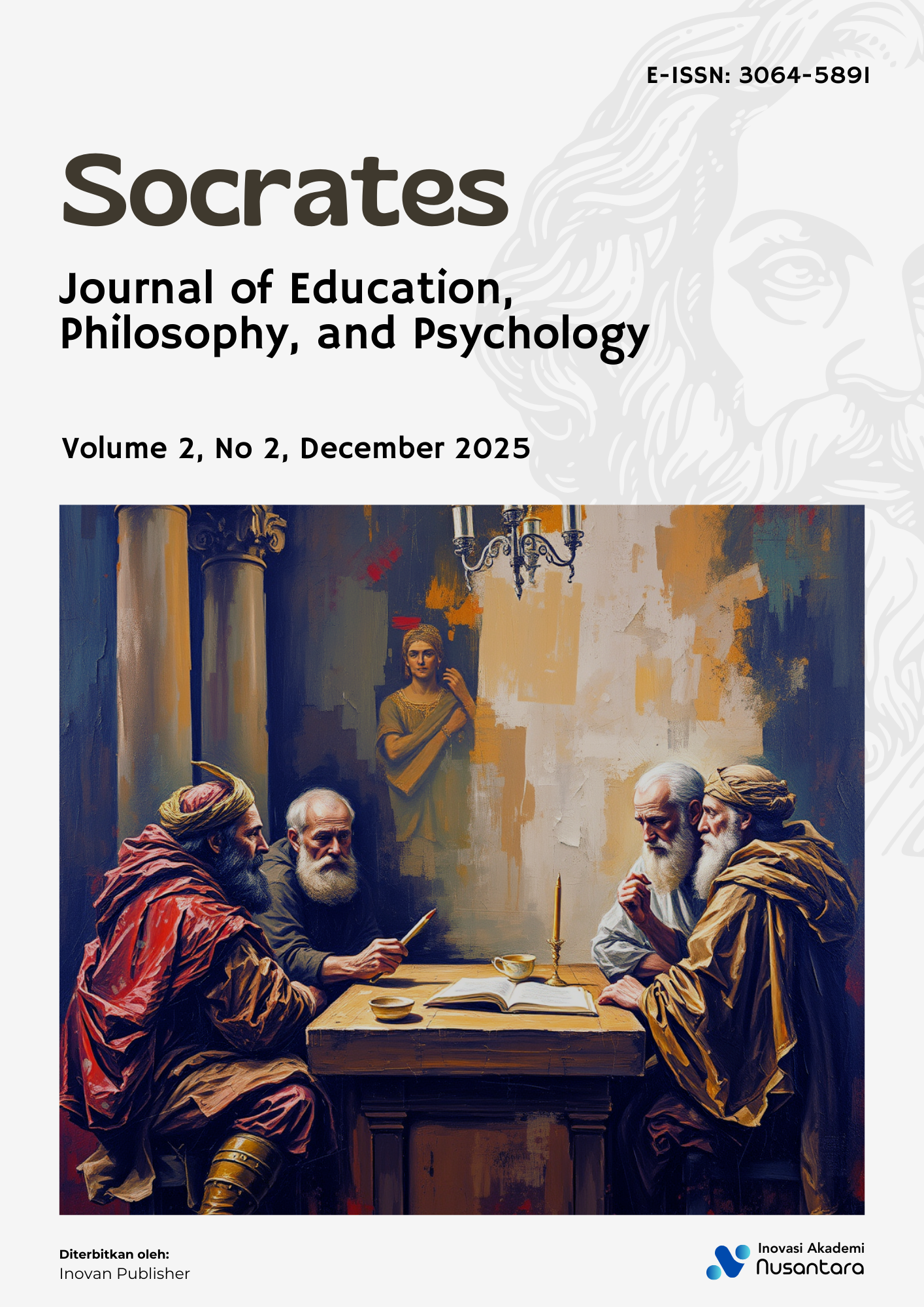
Home/ Archives/ Vol. 2 No. 2 (2025): Socrates: Journal of Education, Philosophy and Psychology
Vol. 2 No. 2 (2025): Socrates: Journal of Education, Philosophy and Psychology

Vol. 2 No. 2 (2025)

Socrates: Journal of Education, Philosophy and Psychology

Published December 1, 2025

This current edition has been available since December 2025.  All articles in this edition consist of (5 original articles) co-authored by 15 authors from 4 university and 1 country (Indonesia)
5 articles 19 authors 1 countries
19

DOIhttps://doi.org/10.63217/socrates.v2i2

  • Articles

    Psychology in Human Resource Management

    Suniyah Nur Fahmi, Hanna Aqeela Humayra, Mochamad Aqshal Saliim, Cindy Tiara Adinda, Arfian Arfian

    Universitas Bhayangkara Jakarta Raya, Jakarta, Indonesia

    pp. 23-29 DOIhttps://doi.org/10.63217/socrates.v2i2.369
    PDF
    Abstract

    This review examines the role of psychology in human resource management (HRM) by emphasizing how principles from Industrial and Organizational Psychology (I/O Psychology) enhance the quality of employee management. Using a literature review approach, the discussion focuses on key HRM functions such as recruitment and selection, training and development, work motivation, performance appraisal, and employee well-being. The findings indicate that psychological approaches improve the objectivity of selection processes, the effectiveness of training transfer, intrinsic motivation, and fairness in performance evaluation systems. The integration of psychological principles also contributes to higher productivity, job satisfaction, and employee retention through the fulfillment of psychological needs, perceived organizational support, and a healthy work environment. These insights highlight that applying psychological principles within HRM is a strategic element for building organizations that are adaptive, sustainable, and oriented toward human well-being.

  • Articles

    The Relevance of Ki Hajar Dewantara's Educational Philosophy with Islamic Values to Form Morally Noble and Progressive Generations

    Raysa Afifa Amelia, Salsabila Salsabila, Muhamad Yahya

    Universitas Islam Negeri Mahmud Yunus Batusangkar, West Sumatra, Indonesia

    pp. 30-37 DOIhttps://doi.org/10.63217/socrates.v2i2.197
    PDF
    Abstract

    This research investigates how Ki Hajar Dewantara's educational philosophy aligns with Islamic teachings to cultivate morally upright and progressive generations. This study addresses the declining moral standards among youth and the need for holistic education integrating local wisdom with religious values. The research novelty lies in exploring the intersection between Ki Hajar Dewantara's educational philosophy and Islamic pedagogy, an area rarely studied integratively. Using qualitative methodology with library research and hermeneutic analysis, this study examines key concepts including Tri Pusat Pendidikan (Three Centers of Education), the among system, Trikon, and Islamic education concepts (tarbiyah, ta'lim, ta'dib). The findings demonstrate strong alignment between Ki Hajar Dewantara's concept of freedom and Islam's fitrah, the among methodology (asih, asah, asuh) with prophetic teaching methods (rahmah, hikmah, mau'idzah hasanah), and Tri Pusat Pendidikan with Islamic emphasis on family, school, and community roles. This synergy can be implemented through integrated curriculum development, teacher role reinforcement, conducive educational environments, and holistic evaluation systems.

  • Articles

    Employe Self-Acceptance in the Human Resources Development (HRD) Department at PT Cabinindo Putra in Facing Work Responsibilities

    Laila Azizah, Nursyaniah Siregar, Putri Satya Permana, Rajif Fadillah Muhammad, Netty Merdiaty

    Universitas Bhayangkara Jakarta Raya, Bekasi, Indonesia

    pp. 38-44 DOIhttps://doi.org/10.63217/socrates.v2i2.265
    PDF
    Abstract

    Employe psychological well-being is an important aspect that not only affects individuals but also the sustainability and effectiveness of the organization. One of the internal factors that plays an important role in shaping psychological well-being is self-acceptance. This study aims to understand the self-acceptance and psychological well-being of employes, specifically Human Resource Development (HRD) staff at PT Cabinindo Putra, a manufacturing company with high work demands related to accuracy, speed, and consistency. This research uses a qualitative approach with data collection methods including in-depth interviews and focus group discussions (FGD). Data analysis is based on Ryff's theory of psychological well-being and Berger's concept of self-acceptance. The research results show that HRD at PT Cabinindo Putra has a good level of self-acceptance, as evidenced by confidence in one's abilities, the use of internal value standards, a responsible attitude toward mistakes, the ability to accept criticism objectively, and a realistic understanding of one's limitations. This condition supports the creation of emotional stability and positive psychological well-being in carrying out the strategic role of HRD. This research is expected to provide an overview of the importance of self-acceptance as a foundation for employe psychological well-being and to be a consideration for organizations in human resource development.

  • Articles

    Dynamics Psychology of Premarital Sexual Behavior Among Students: A Phenomenological Study

    Raisah Zettira Hermawan, Budi Sarasati, Yomima Viena Yuliana

    Universitas Bhayangkara Jakarta Raya, Jakarta, Indonesia

    pp. 45-50 DOIhttps://doi.org/10.63217/socrates.v2i2.280
    PDF
    Abstract

    This study explores the psychological dynamics of premarital sexual behavior among female university students within romantic relationships, using a descriptive phenomenological approach. The research aims to understand how participants experience, interpret, and assign meaning to their involvement in premarital sexual behavior. Two female undergraduate students who had direct experiences with premarital sexual behavior participated in the study, supported by close informants to strengthen data credibility. Data were collected through semi-structured in-depth interviews, observation, and documentation, and analyzed using thematic analysis. The findings reveal that premarital sexual behavior emerged from complex interactions between emotional intimacy, trust in partners, curiosity, environmental normalization, and expectations of long-term commitment. Sexual involvement was interpreted as a form of expressing love, emotional validation, and an effort to maintain romantic relationships. However, an imbalance between high intimacy and passion with unstable commitment generated emotional vulnerability, particularly when participants’ expectations of reciprocity and seriousness were unmet. Feelings of confusion, insecurity, fear of abandonment, and self-doubt were prominent psychological consequences following sexual involvement. This study concludes that premarital sexual behavior among female students cannot be understood merely as risky behavior, but rather as a meaningful psychological experience shaped by emotional needs, relational contexts, and sociocultural influences. A contextual and holistic understanding is essential for developing more empathetic educational and psychological interventions related to sexuality among young adults.

  • Articles

    Psychological Safety and Employee Work Productivity: A Literature Review of Psychology and Human Resources

    Raihan Saputra, Yuarini Wahyu Pertiwi, Jumawan Jumawan

    Universitas Bhayangkara Jakarta Raya, Jakarta, Indonesia

    pp. 51-59 DOIhttps://doi.org/10.63217/socrates.v2i2.331
    PDF
    Abstract

    Employee work productivity is a key factor influencing organizational effectiveness and competitiveness. In addition to technical and managerial factors, psychological factors have increasingly been recognized as important determinants of employee performance. One of these factors is psychological safety, defined as an individual's perception of being able to express opinions, ask questions, share ideas, and admit mistakes without fear of negative consequences. This study aims to review and synthesize previous research findings regarding the relationship between psychological safety and employee work productivity. This study employed a literature review method by analyzing relevant articles obtained from several academic databases, including Google Scholar, Scopus, ScienceDirect, SpringerLink, Wiley Online Library, and Taylor & Francis Online. The selected literature was reviewed systematically based on predetermined inclusion and exclusion criteria. The findings indicate that psychological safety has a positive relationship with employee work productivity. Employees who experience higher levels of psychological safety tend to engage in open communication, knowledge sharing, collaboration, and innovative behavior, which contribute to improved work effectiveness and efficiency. Furthermore, psychological safety enhances work engagement and organizational learning, leading to better performance outcomes. In contrast, low psychological safety may hinder communication, increase work stress, and reduce productivity. The review highlights the importance of creating a psychologically safe work environment as a strategy for improving employee productivity and supporting sustainable organizational performance.

logo-soc

Socrates: Journal of Education, Philosophy and Psychology

e-ISSN 3064-5891

Editorial Office

  • inovan.info@gmail.com
  • +62 821-2435-5730
© 2026 Inovan Publisher Theme Zenith by Nosadev