Skip to main content Skip to main navigation menu Skip to site footer
logo-soc
  • Current
  • Archives
  • About
    • About the Journal
    • Submissions
    • Privacy Statement
    • Contact
  • Login

Search Socrates: Journal of Education, Philosophy and Psychology

Press Enter to search · Esc to close Advanced search →
logo-soc
  • Current
  • Archives
  • About
    • About the Journal
    • Submissions
    • Privacy Statement
    • Contact
  • Login
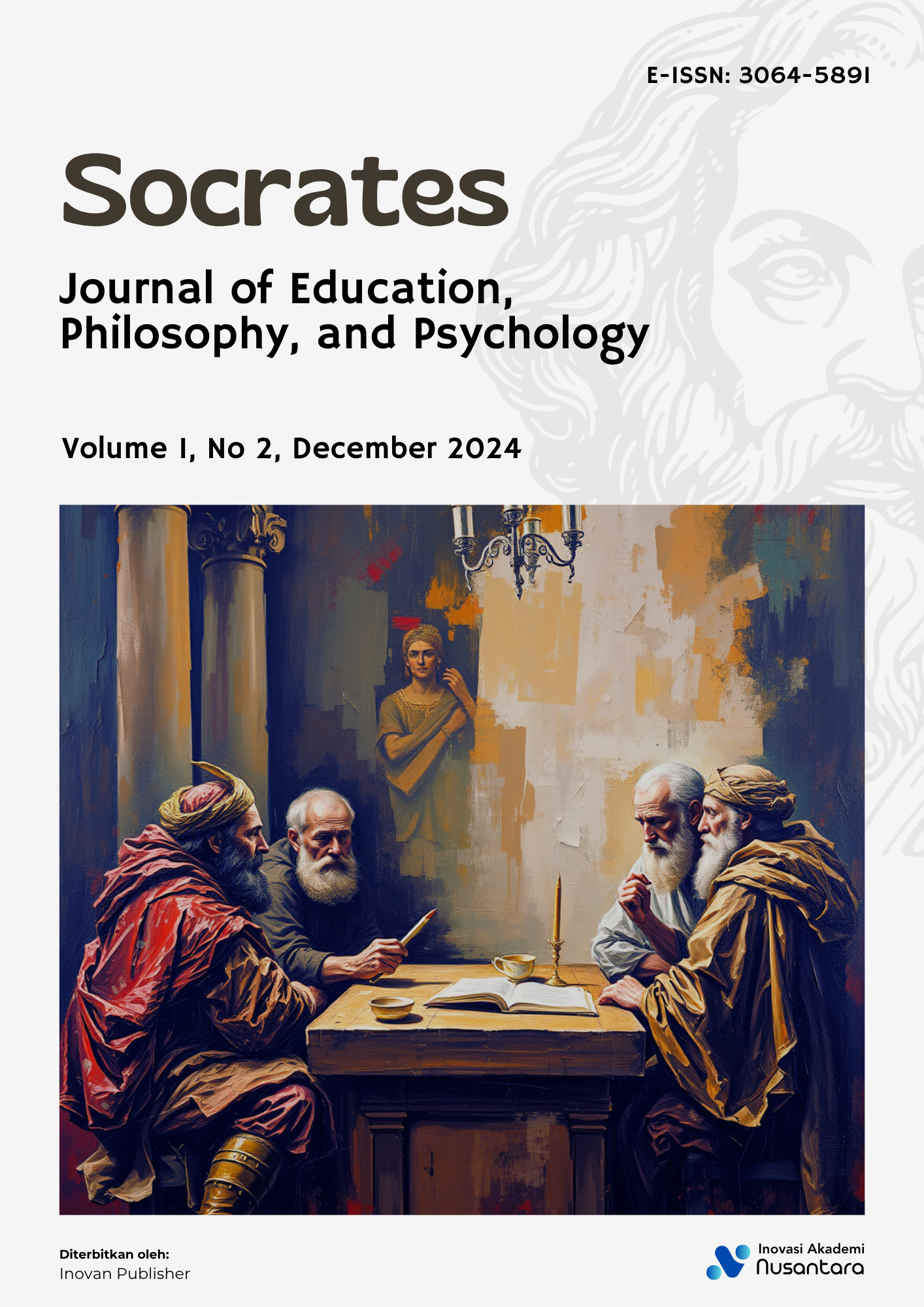
Home/ Archives/ Vol. 1 No. 2 (2024): Socrates: Journal of Education, Philosophy and Psychology
Vol. 1 No. 2 (2024): Socrates: Journal of Education, Philosophy and Psychology

Vol. 1 No. 2 (2024)

Socrates: Journal of Education, Philosophy and Psychology

Published December 1, 2024

This edition has been available online since December 2024. All articles in this edition consist of (5 original research articles) co-authored by 13 authors from 2 Universities and 1 Country (Indonesia).
5 articles 13 authors 1 countries
13

DOIhttps://doi.org/10.63217/socrates.v1i2

  • Articles

    Philosophical Approach in Islamic Education: Improving the Quality of Education Through Dialogue and Reflection

    Dani Rustani, Hermina Nurhasanah, Serly Nurmayanti, Yayan Hidayat

    STITNU Al Farabi Pangandaran, Jawa Barat, Indonesia

    pp. 34-40 DOIhttps://doi.org/10.63217/socrates.v1i2.107
    PDF
    Abstract

    In this scientific paper, the author lists several problems that are currently occurring in the world of education in Indonesia, one of which is the learning process which is currently experiencing a lot of development and progress. With this development and progress, it is inseparable from the urgent demands to improve the quality of education, how to improve the quality of education today? The main purpose of writing this scientific paper is to find out the strategies carried out by educators towards students to improve the quality of education in Indonesia. This study utilizes a Qualitative Descriptive approach, which begins with finding primary information focused on literature studies (Library Research), namely a study that focuses on finding library data and describing it, a systematic description of data collections, descriptive descriptions do not use numbers. The results of this study state that the philosophical approach between educators and students by applying the dialogue and reflection learning method will greatly influence the improvement of the quality of education in Indonesia.

  • Articles

    The Influence of Local Culture on Islamic Education in Indonesia

    Azmillulloh Askarul Jabar, Sania Aqil Salsabila

    STITNU Al Farabi Pangandaran, Jawa Barat, Indonesia

    pp. 41-44 DOIhttps://doi.org/10.63217/socrates.v1i2.108
    PDF
    Abstract

    The influence of local culture on Islamic education in Indonesia is reflected in the integration of cultural values into the curriculum, teaching methods, and interactions within educational environments. Indonesia’s cultural diversity creates opportunities for harmonization between local traditions and Islamic teachings, ultimately enriching students’ learning experiences. Values such as mutual cooperation, local wisdom, and social norms contribute to shaping students’ character in understanding and practicing Islamic teachings. This integration not only strengthens Islamic identity but also enhances the education system with a more contextual and inclusive approach. Keywords: Local Culture, Islamic Education, Cultural Values, Cultural Integration, Indonesia.

  • Articles

    Analysis of Literacy Programs in Increasing Students' Reading Interest in Schools

    Asih Tri Lestari, Didan Faisal, Dinda Adila Aprina, Rahma Fauziah Azzahra, Irpan Taupik

    STITNU Al Farabi Pangandaran, Jawa Barat, Indonesia

    pp. 45-50 DOIhttps://doi.org/10.63217/socrates.v1i2.109
    PDF
    Abstract

    School libraries play a crucial role in supporting the learning process and developing students' literacy. As information centers, they provide a diverse range of reading materials and enhance understanding and critical thinking skills. Literacy encompasses reading, writing, and comprehension abilities that are essential in education. Well-implemented literacy programs strengthen students' skills in accessing, analyzing, and utilizing information across various contexts. Students' reading interest is a key factor in the success of these programs and can be fostered through engaging literacy activities with support from families and schools. The involvement of stakeholders such as government bodies, educational institutions, and communities is vital for creating an environment that encourages reading habits. With effective library management and collaboration among all parties involved, literacy programs can positively impact educational quality and prepare students to face global challenges.

  • Articles

    The Relationship Between Academic Stress and Psychological Well Being of SMA Negeri 1 Pantai Cermin Students During the Covid-19 Pandemic

    Bunga Islami Yusa

    Universitas Negeri Padang, Padang, Indonesia

    pp. 51-59 DOIhttps://doi.org/10.63217/socrates.v1i2.159
    PDF
    Abstract

    Since 2020, the world, including Indonesia, has been declared infected with a virus that is considered dangerous and has claimed many lives, namely the Covid-19 virus. In order to reduce the transmission rate, the government has issued various policies, one of which is a policy in the learning process where the learning process is limited or carried out online. However, the learning process may be carried out offline by meeting the applicable requirements. This change in the learning system is considered less effective and can trigger stress for students so that it can affect their psychological well-being. The purpose of this study is to see the relationship between academic stress and psychological well-being of students at SMA Negeri 1 Pantai Cermin during the Covid-19 pandemic. The scales used in this study are the Psychological Well-Being Scale and the Academic Stress Scale carried out by the researcher. This study was conducted on 169 subjects from SMAN 1 Pantai Cermin using the incidental sampling technique. The correlation analysis in this study used the Pearson Product moment correlation technique with the results of the correlation between academic stress and psychological well-being, namely r = -0.285 with a significance value of p = 0.000, so Ha is accepted. This means that there is a significant negative relationship between academic stress and psychological well-being in students of SMAN 1 Pantai Cermin.

  • Articles

    Academic Stress Levels in Junior High School Students During Covid-19 Online Learning

    Ines Rahayu

    Universitas Negeri Padang, Padang, Indonesia

    pp. 60-65 DOIhttps://doi.org/10.63217/socrates.v1i2.160
    PDF
    Abstract

    Academic stress levels in junior high school students during online learning due to COVID-19. The purpose of this study was to examine the level of academic stress in junior high school students in Kedepatian Semerap. This study used a quantitative method with descriptive analysis. The population in this study was all junior high school students in Kedepatian Semerap, with a sampling technique using accidental sampling with a total of 63 participants. The results showed that the level of academic stress in junior high school students during online learning was in the moderate category.

logo-soc

Socrates: Journal of Education, Philosophy and Psychology

e-ISSN 3064-5891

Editorial Office

  • inovan.info@gmail.com
  • +62 821-2435-5730
© 2026 Inovan Publisher Theme Zenith by Nosadev